

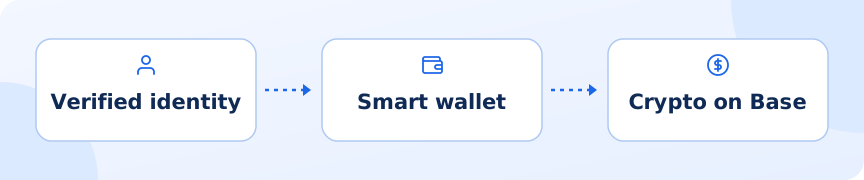
Crypto, shown in dollars
Crypto, shown in dollars
Numpay moves crypto between wallets. The crypto it uses is pegged 1:1 to the US dollar, so its value doesn’t swing, and the app shows your balance and every payment as plain dollar amounts.The exact token and contract are covered in the technical section: see Tech stack.
Base: the network
Base: the network
Base is an Ethereum layer 2 network built by Coinbase. Transfers confirm in about two seconds and cost a fraction of a cent. Numpay’s production app runs on Base mainnet (chain ID 8453). A testnet build also runs on Elysium.
Mobile number or email as your identity
Mobile number or email as your identity
You don’t have an account name or a long wallet address to share. People pay you by your mobile number (in international E.164 format, for example
+14155550123) or your email address. You prove you own it by typing a one-time code.Your smart wallet
Your smart wallet
Your money lives in a smart wallet: a small program on Base (a ZeroDev Kernel account) that only accepts instructions signed by your key. Compared with a plain wallet it can have its fees paid by someone else, which is how Numpay makes transfers free for you.Your wallet address is calculated from your key, so it’s the same every time you sign in, on any device, and it exists even before its first transaction.
Your key, without a seed phrase
Your key, without a seed phrase
Signing in with a one-time code gives the app your private key through Web3Auth (MetaMask Embedded Wallets). The key is split across Web3Auth’s network and only reassembled for you after you pass the code check. There is no seed phrase to write down. Numpay’s servers never see this key.
Sponsored gas
Sponsored gas
Every blockchain transaction has a small network fee called gas, normally paid in ETH. Numpay uses a paymaster, a service that pays the gas for each transfer on your behalf. You only ever hold the crypto you send and receive.
Claimable wallets
Claimable wallets
When you pay a mobile number or email that isn’t on Numpay yet, the server creates a claimable wallet for it and holds its key, encrypted. The money waits there. When the owner of that number or email signs in for the first time, Numpay moves the full balance to their own wallet and deletes the stored key.
Requests and payment links
Requests and payment links
A request asks someone to pay you a set amount. A direct request is addressed to one mobile number or email; a global request produces a link anyone can pay. Both give you a link in the form
https://app.numpay.app/send?requestId=<id>.